
Research and Evidence
The Numbers
2 Million +
People
Treated for
depression to date.
$10.55
Current cost to treat one person for depression
74%
Of participants, on average, are
depression-free after therapy ends.
Research, Evaluations, and Case Studies
Our innovations in scaling access to depression treatment are backed by research, rigorous monitoring and evaluation, and external validation.
2026
RCT · PREPRINT · IN PEER REVIEW
Group Interpersonal Psychotherapy for Depression in Uganda:
Intervention effects and the influence of social desirability bias in a pilot cluster randomized trial
Group interpersonal psychotherapy (IPT-G) can expand access to depression care, but assessment conditions may influence outcomes. This pilot cluster-randomized trial refined outcome-measurement procedures and generated preliminary effect estimates for a larger trial. We evaluated a six-week model, examining associations between follow-up conditions and depressive symptoms.
2026
RCT · PREPRINT · IN PEER REVIEW
Beyond Reductions in Depressive Symptoms:
Functional, social, and household outcomes in a pilot cluster-randomized controlled trial of group interpersonal psychotherapy in rural Uganda
Group interpersonal psychotherapy may improve outcomes beyond depressive symptoms, but evidence on functioning, social support, and household welfare remains limited. This pilot cluster-randomized controlled trial examines these outcomes using mixed methods in a pilot cluster-randomized controlled trial of a six-week intervention in rural Uganda.
 2026
2026
CASE STUDY
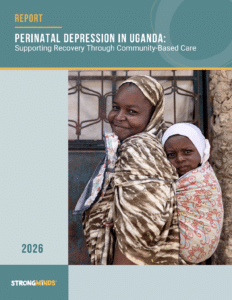
Perinatal Depression in Uganda:
Supporting Recovery Through Community-Based Care
This report examines the impact of community-based group therapy on women experiencing perinatal depression in Uganda, highlighting the personal stories of recovery that underscore the need for greater investment in maternal mental health.
 2026
2026
CASE STUDY
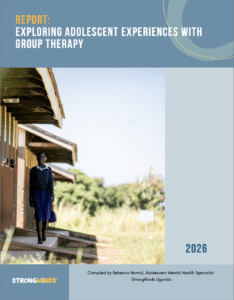
Exploring Adolescent Experiences with Group Therapy
Qualitative findings on how adolescents experience and benefit from group interpersonal therapy.
Drawing on insights from 213 former participants across 11 districts, this report highlights improvements in mental health, life skills, relationships, and overall well-being in adolescents who have completed IPT-G in Uganda.
2026
EVALUATION REPORT
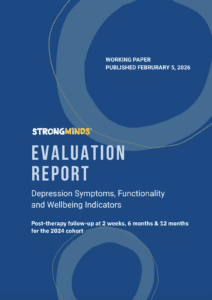
12- Month Follow-Up Evaluation Report:
Depression Symptoms, Functionality and Wellbeing Indicators Pre-post client data showing sustained symptom reduction and functional improvement after group therapy.
This report shows that the benefits of StrongMinds’ six-week group therapy program can last well beyond treatment. The findings demonstrate the potential of a low-cost, community-based model to deliver lasting impact at scale.
 2025
2025
CASE STUDY
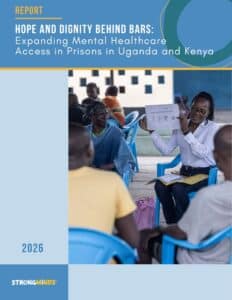
Hope and Dignity Behind Bars:
Expanding Mental Healthcare Access in Prisons in Uganda and Kenya
This report explores how StrongMinds’ group therapy program is helping incarcerated people manage depression, strengthen relationships, and build more hopeful futures. It shares the program’s approach, results, and lessons learned—and highlights the potential for prison-based mental health care to create safer environments and support lasting change.
2025
RCT · PEER REVIEWED
Six-Week Problem Area–Concordant vs 8-Week Problem Area–Discordant Group Interpersonal Psychotherapy
In this randomized clinical trial of 328 participants, problem area–concordant 6-week IPT-G was non-inferior to 8-week problem area–discordant IPT-G. Nine-Item Patient Health Questionnaire scores dropped by nearly 2 additional points compared with the 8-week group, and this difference was maintained after 3 months. The study showed that shortening IPT-G while grouping clients with a common depression problem area offers a promising approach to increase depression treatment efficiency and scalability.
2025
CLASS ANALYSIS STUDY · PEER REVIEWED
Retention and effectiveness of group interpersonal psychotherapy (IPT-G) to treat depression at scale in Uganda and Zambia
This study found that clients attending in-person group therapy were more likely to remain engaged than those participating by phone. Across the full study population, greater attendance was associated with larger reductions in depressive symptoms. The findings also underscore the importance of early engagement, particularly for younger clients and those entering treatment with moderate depression.
 2024
2024
EVALUATION REPORT
Pre- and Post-treatment Measures from Clients Across Our 2024 Program Cycle.
This independent evaluation found large reductions in depressive symptoms among 575 StrongMinds clients in Uganda and Zambia. Average PHQ-9 scores fell from 15.3 before therapy to 3.2 two weeks after treatment, alongside improvements in daily functioning and well-being. The findings are consistent with previous evaluations and support further long-term and randomized research.
 2024
2024
CASE STUDY
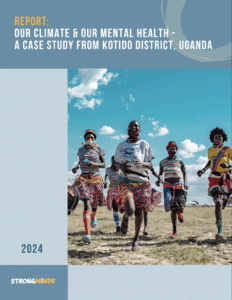
Climate Change and Mental Health in Africa
This report explores how climate change is contributing to depression in Uganda’s semi-arid Kotido District, where drought, loss, displacement, and disrupted livelihoods are reshaping daily life. It also shows how community-based group therapy can help people manage depression, strengthen resilience, and adapt to a changing climate.
 2024
2024
EVALUATION REPORT
Pre- and Post-treatment Measures from Clients Across Our 2023 Program Cycle.
This report shares the results of the 2023 pre-post evaluations of StrongMinds clients. Clients were measured pre-treatment by their counselors, and post-treatment by independent surveyors two-weeks post-therapy and six-months post-therapy.
 2024
2024
CONTROLLED, QUASI-EXPERIMENTAL STUDY
Measuring the Impact of Group Interpersonal Therapy (IPT-G) on Adult Women with Depression in Uganda
Research Iganga and Mukono Districts from 2019-2020 showed that, while depressive symptoms improved in both control and treatment groups over the one-year study period, participants who received IPT-G experienced substantially greater and faster gains. The difference was especially pronounced at six months, and at one year the treatment group’s average PHQ-9 score remained less than half that of the control group: 2.63 compared with 5.48.
 2021
2021
REPORT
Teletherapy to Treat Depression in Women in Sub-Saharan Africa
A qualitative assessment of phone-based group interpersonal therapy (IPT-G) as a depression intervention in Uganda and Zambia during the COVID-19 pandemic.
 2020
2020
REPORT
COVID-19 and Mental Health in Africa
A survey of 12,000 women in low-income communities in Uganda and Zambia conducted by StrongMinds to assess the mental health impacts of COVID-19 on its former clients.
2016
EVALUATION REPORT
Phase I and Phase II Follow-up Report
A summary follow-up data from the first two cohorts of women treated during our initial pilot phase, indicating that more than two-thirds of the women remained depression-free 18 and 24 months beyond the conclusion of therapy.
2015
EVALUATION REPORT
Phase II Impact Report
A summary of results from our second cohort of women treated with depression through Group Interpersonal Therapy during our initial pilot phase
2014
EVALUATION REPORT
Phase I Impact Report
A summary of results from our first cohort of women treated with depression through Group Interpersonal Therapy during our initial pilot phase.
 2025
2025
EXTERNAL VALIDATION
World Happiness Report
StrongMinds was named one of the world’s most cost-effective charities at improving happiness in the 2025 World Happiness Report.
 EXTERNAL VALIDATION
2024
TIME100 Health
In their inaugural issue of TIME100 Health, TIME highlighted the work of Sean Mayberry, the founder and CEO of StrongMinds, for its work scaling depression treatment in Africa.
 EXTERNAL VALIDATION
2022
World Mental Health Report
StrongMinds is featured as an exemplar of community-based mental health organizations in this World Health Organization (WHO) report, which presents evidence and case studies of good practices worldwide.