
Mental Health Care for Communities Rebuilding After Displacement
For many refugees, depression follows them long after they reach safety, now shaped by grief, violence, family separation, and the uncertainty of settlement life. And the impact isn’t limited to refugees alone. Host communities live alongside them, sharing the same stretched schools, clinics, and water points, and carrying much of the same emotional weight of displacement and scarcity.
That’s why StrongMinds treats this as one shared reality, not two separate problems, ultimately bringing depression care to refugees and host community members side by side, since both are needed for the model to work.
Uganda hosts approximately two million refugees, making it the largest refugee-hosting country in Africa.
Sub-Saharan Africa hosts 18 million refugees, accounting for a quarter of the world’s refugee population.
32% of displaced people experience depression.
Group Therapy, Adapted for Displacement
We deliver the same six-week Interpersonal Group Therapy model used across our programs, but adapted specifically for the realities of displacement. That means training local volunteer facilitators, many of them former clients themselves, so care is delivered in the right language, by people who understand what displacement feels like from the inside.
Trauma-Sensitive By Design
Groups move at a pace that respects what participants are ready to share.
Facilitated by the Community
Many facilitators are former clients, giving them credibility that outside training alone can’t provide.
Built for Mobility and Flexibility
Flexible scheduling and follow-up help participants stay connected to care even as families move between settlements.
Trauma-Sensitive Care & Psychological First Aid
Standard group therapy isn’t built for people carrying the weight of conflict, flight, and loss. In refugee settings, the model itself has to change, starting with when and how care is offered.
Facilitators are trained to meet that with patience, not urgency: building safety and trust before ever asking someone to speak about pain.
Psychological First Aid (PFA) is our first layer of care, offered before anyone enters a full six-week therapy group. It’s a humane, practical response for people in acute distress, built around a simple framework: Look, Listen, and Link.
- Look: Volunteers assess physical and emotional needs through respectful, open communication, without forcing anyone to engage before they’re ready.
- Listen: Trained facilitators offer a non-judgmental space to talk, paired with grounding techniques like breathing exercises to help people regain composure.
- Link: Volunteers connect people to essential resources, food, water, emergency medical care, and to partner organizations like the Uganda Red Cross, ACORD Uganda, and the Baylor Foundation, through clear referral pathways.
PFA started in 2024 as part of our emergency response work. We’re now expanding it beyond acute crises, into transit centers, climate displacement settings, and other points where people need immediate, practical support before they’re ready for a full course of care.
We’ve trained 80 volunteers to deliver PFA at reception centers and large gatherings, where it also serves as an early screening point, helping identify who may benefit from a full therapy group. StrongMinds sees mental health as part of the first response, not something addressed only once it reaches a crisis point.
Why It’s Important
PFA isn’t a replacement for our therapy groups. It’s what happens before them, and that timing matters.
Most people arriving at a reception center, or living through the aftermath of a crisis, aren’t ready for a six-week commitment. What they need first is someone who notices confusion, fear, or withdrawal, and responds without pressure.
That early response makes a big difference. It reduces acute distress before it hardens into longer-term trauma. It gives people a compassionate, non-clinical way into care, so that by the time they’re ready for a full screening or therapy group, they’re not starting from crisis. And it restores something displacement takes away: a sense of control, connection to basic needs, and a clear path to the people who can help.
Named a Global Winner: Van Leer Foundation’s Good Start Challenge
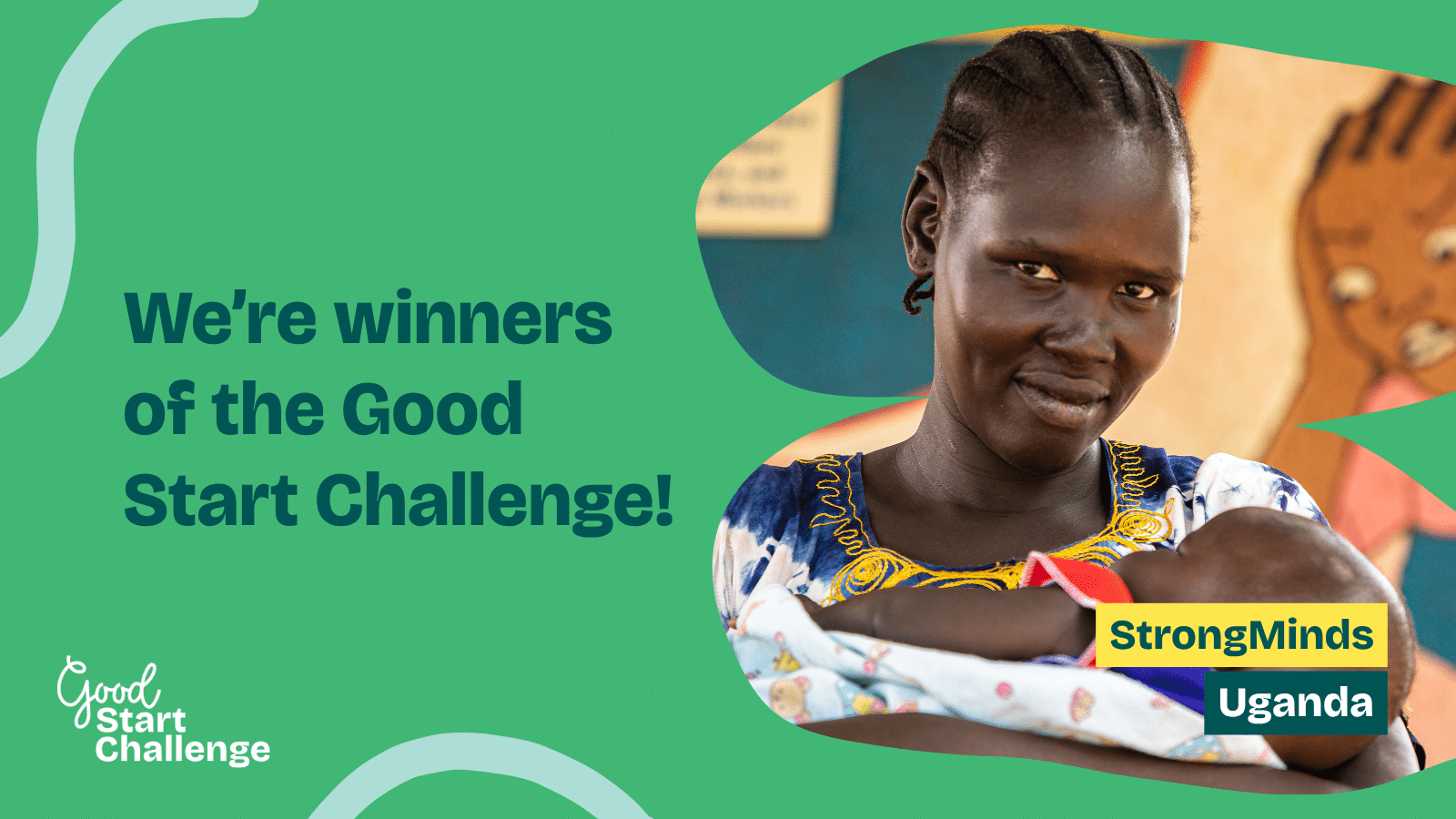
StrongMinds is one of six global winners of the Van Leer Foundation’s Good Start Challenge, an initiative supporting innovative solutions for parental and caregiver well-being.
Our winning solution, Integrated Mental Health Care for Refugee Families, brings free six-week group therapy to refugee parents experiencing depression in northern Uganda, delivered by trained local volunteers.
Growing Alongside Uganda’s Refugee Settlements
What began as a single pilot in Lamwo has grown into a presence across several of Uganda’s largest refugee-hosting districts.
Lamwo District
Our first refugee settlement program, started in 2019.
Adjumani District
Our work with the Good Start Challenge focuses on caregiver mental health & early childhood.
Isingiro District
Nakivale Settlement
Obongi District
Palorinya Settlement
Yumbe District
Bidibidi Settlement
Terego District
Imvepi Settlement
What We Hope to Build Next
Years of working in displacement settings have shaped a clear set of priorities for where this program goes from here.
Volunteers aren’t just delivering a model — they’re sitting with people carrying grief, displacement, and loss. Supervision needs to account for what that takes: support when participants move or go missing, when a story is heavier than expected, when language barriers get in the way, or when a concern goes beyond what therapy alone can address. We want to build systems that keep facilitators confident and supported, while recognizing the emotional weight they carry as community-based caregivers.
When a caregiver is depressed, it shapes how they feed, respond to, and play with their child, and in families already stretched by displacement, that can affect a child’s earliest development. Building on lessons from our Good Start Challenge work, we want to bring child play directly into caregiver support, giving parents a way back into connection with their children and helping rebuild the routines and responsiveness that depression can interrupt.
Making trauma-informed practice a built-in part of the model everywhere it’s delivered — not an add-on. That means facilitators never rush someone toward disclosure, using language that doesn’t blame and pacing that respects what a person can hold. Some participants are ready to speak in week one; others carry their pain in silence for weeks before they trust the group. The goal is for every space we run to feel safe by default, not only when a facilitator happens to get it right.