
In Conversation: Rose and Her Lifetime of Community Work From Community Mobilization to Mental Health
Rose has spent more than two decades at the heart of community work in Kabwe, Zambia, in the same area where she was born and raised. She is a community mobilizer and StrongMinds group therapy facilitator, helping to introduce mental health support to a community that, at first, didn’t have the language or the openness to talk about depression. Through client mobilization and psychoeducation, she has helped shift that conversation, reducing stigma and building trust so people feel comfortable seeking help.
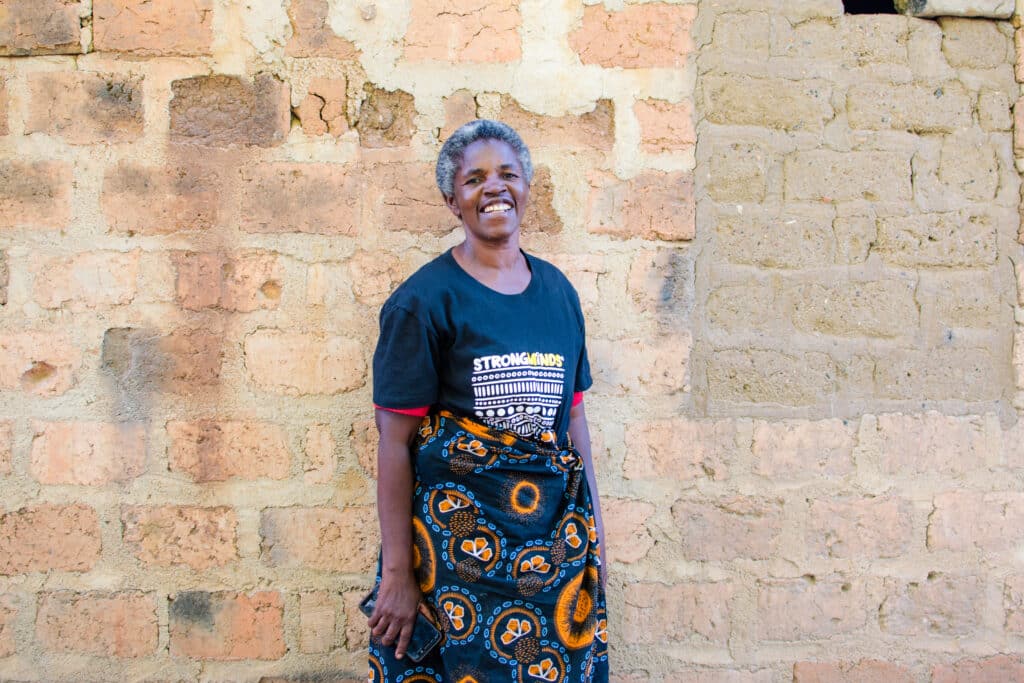
Today, Rose facilitates therapy groups for both women and men, adapting her approach for each. She draws on cultural traditions, shared community history, and a deep understanding of her neighbors to help people, especially men, open up when it doesn’t come naturally. She has also become a trusted guide for community members navigating some of the area’s toughest challenges, always connecting mental health support to the everyday realities people face.
Below, Rose shares what she’s learned over her years of service, the moments that have stayed with her, and what continues to motivate her work.
This interview was conducted with the support of an interpreter and has been lightly edited for clarity and length. Some responses may not be exact, word-for-word translations, but every effort was made to preserve the meaning and spirit of what Rose shared.
Q: What do you love about community mobilization?
A: I love that the community knows me. Whenever there’s a program, as soon as people hear my name mentioned, they feel comfortable coming.
Q: How did the community first respond to conversations about depression and mental health?
A: At first, it was hard because people didn’t understand, but through mobilization, sensitization, and psychoeducation, people have accepted the program.
There is still some stigma. At the start, people would often say things like, “It’s normal for me to feel what I’m feeling; this is how we are built.” Because stigma around depression can contribute to suicide, the work we’ve done has reduced stigma, and the community is now more protective and accepting overall.
Q: What differences do you see between groups of men versus women?
A: Women tend to accept support and therapy more quickly than men. It’s easier for women to open up about their challenges during the session itself, but men take longer and need different approaches to open up. They often feel shy, worried that other men will look down on them.
Q: Have you gotten better, over time, at helping them open up sooner?
A: Yes. Over my years working with StrongMinds, I’ve developed strategies to help men open up more quickly. I appeal to unity: we are all one Zambia, one nation, so if women are getting help, men should too.
I draw on shared experience, like childhood games and things the community used to do together.
I use a cultural reference point: the insaka, a traditional thatched gathering house where men would traditionally sit, share a drink, and talk about their problems. I encourage men to bring that same openness into the group session.
Q: How do you think helping men helps women?
A: When men open up in the group about their challenges, it helps them realize they’re not alone, and they get insight and support from others on how to manage things in their marriage. This in turn helps the family and the wife, because the husband learns how to better care for and protect his wife and children, which improves the relationship between them.
Q: What is leading a therapy group like?
A: I relate it to being like a teacher, helping guide people toward a better way of life and supporting change. I compare it to a traditional role in my culture: a woman who gives traditional teaching to women (and men) before marriage. I see my facilitation role similarly, as someone supporting people to do things better together.
Q: What are participants in a group like at first, in session one?
A: Session one is usually the trickiest, because everyone coming is uncertain what to expect: what therapy actually is, how it works, what they’ll get out of it. This is also where I get a read on whether the group will be participatory and willing, or whether it might be a group that presents more challenges in staying engaged.
Q: What improvements do you first notice in people?
A: When clients share what’s contributing to their depression and get support from the group, they start to show signs of change. [One] area of change is self-care. In session one, some women arrive not well-kept: dirty wrappers [the colorful skirts Zambian women wear], no shoes, uncombed hair. As they progress through support, they start coming to sessions with washed wrappers, combed hair, and lotion applied.
Q: What challenges do you think facilitators face?
A: When I first started as a StrongMinds volunteer, I had difficulty mobilizing people to leave their daily duties and come sit with me. I’ve since learned better ways to bring people together, and now some people come seeking me out directly.
Q: Do you think facilitating and hearing about other people’s struggles impacts your own mental health?
A: Yes. There are times when what clients share relates to something I’ve gone through or am going through myself. My strategy is to take in the same support and suggestions I give to that client, and apply them to my own situation as well.
I also work closely with my coach. During pre-group screening, if I notice a client’s triggers might affect me personally or affect the quality of the therapy I’m able to give, I let my coach know, so she can be present that day and support me, ensuring clients still get the support they need.
My coach and I also debrief regularly and check through a task list before sessions, confirming I have what I need: visual aids, a mat for clients to sit on, attendance registers, pens, and so on.
Q: What are the biggest challenges that the community faces?
A: Lack of water.
Q: Can you tell me more about the specific impacts that water has on the community?
A: The lack of water contributes to health issues like cholera. People end up reusing water for multiple purposes, for example, reusing water after washing clothes for other chores. Many delay going to their businesses because they need to secure water and bathe first. By the time they reach the marketplace, they’ve lost time and sales they could have made.
Q: How do you think this emotionally impacts the community?
A: The water shortage has gone on for a long time. There’s a water kiosk just across the road that has been out of service for three years. Our community now relies mainly on a borehole drilled by a private resident, since the government-run kiosk is not working.
Even when the government one was operating, it ran limited hours, roughly 6 to 12 hours a day before shutting, then reopening later, not enough given how many households depend on it. Community members feel neglected. Many complaints have been filed with the water and sewerage company about non-functioning kiosks, and people feel sad and undervalued, asking why they aren’t being considered. Water is life.
Q: What keeps you motivated to continue doing what you’re doing?
A: Seeing people I’ve treated in past cycles come back to express appreciation for the support I gave them. Some had been close to broken relationships between siblings, spouses, or other relatives, and now they’re happy to see me and to share how therapy helped them. I also find motivation in wanting my community to be free of depression: a free mind. Free of depression, [that] is what really keeps me invested in continuing this work.