
A Fireside Chat with our Expert on Mental Health in Prisons
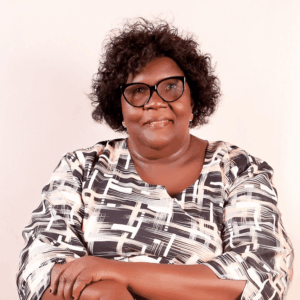
Faith Bothuwok Fuachan developed—and now coordinates—StrongMinds’ peer-led mental health program in Uganda’s prisons. Her 25-year career uniquely prepared her to take on the challenge of prison-based mental health care.
She began as a Registered Psychiatric Nurse, working across high-pressure wards—including criminal units—supporting patients with counseling, family engagement, and reintegration. She later managed community programs at Uganda’s National Referral Mental Hospital and spent a decade at the African Centre for Treatment and Rehabilitation of Torture Victims.
Drawing on this clinical experience and her deep compassion, Faith envisioned a model where inmates deliver peer-to-peer mental health support. As a StrongMinds program coordinator, she partnered with the Uganda Prisons Service to launch a program that has transformed the lives of thousands of incarcerated men and women. Her approach is now spreading to other countries, with the potential to transform mental health in African prisons.
In this interview, Faith offers a behind-the-scenes look at the work.
Q: Why do prisons need mental health programming?
Faith: Prisons are environments with a wide range of mental health challenges. Many inmates experience depression due to the drastic change in environment, long periods of confinement, and extended time on remand. Overcrowding, lack of visits from loved ones, and strained family relationships also take a toll. Some women, for example, face neglect from their husbands or feel constant stress about the families they’ve left behind. Loneliness, anxiety, disrupted eating patterns, and the lack of basic necessities all contribute to poor mental health among incarcerated individuals.
Q: What does your role at StrongMinds entail?
Faith: In my role at StrongMinds Uganda, I lead the mental health programs within the prisons, police, and army. I make sure our group talk therapy sessions run smoothly and effectively, bringing a simple, faster way to treat depression in these challenging environments.
A big part of my job is providing guidance and coordination. I work closely with the Ministry of Health, the Ministry of Internal Affairs, and other government partners to make sure our approach fits within national systems. I also collaborate with StrongMinds staff to integrate their expertise so that our programs stay effective and client-focused.
I handle reporting and documentation, tracking our progress and sharing lessons with both internal teams and external partners. I’m also involved in advocacy, raising awareness about mental health, reducing stigma, and helping strengthen systems so that prisons, police, and the army can better support people struggling with depression.
As a team leader, I focus on building capacity and helping my team grow professionally.
Q: What work did you do before working at StrongMinds?
Faith: Before joining StrongMinds, I worked as a Registered Psychiatric Nurse for about 15 years. At times, I worked in a unit in the hospital for prisoners and at other times I worked in general psychiatric units. I then spent three years managing community mental health programs at the National Referral Mental Hospital, and later worked with the African Centre for Treatment and Rehabilitation of Torture Victims for 10 years.
Q: How did your previous work prepare you for your role at StrongMinds?
Faith: This was an intense and valuable experience. I was in charge of several wards – admission, convalescent, sick, and criminal wards, for both male and female patients. My work involved talking with patients, counseling their families, and helping resettle recovered clients back into their communities. I also spent time engaging communities in dialogue about mental illness, its effects, and the stigma that often surrounds it. In addition, I attended and presented papers at mental health conferences across several African countries, which broadened my perspective on mental health care on the continent.
Q: Do you ever feel concerns for your own safety when working inside a prison?
Faith: No, not at all because the prison is on 24 hour surveillance and therefore I am not afraid. These are human beings like me. Today I am outside but tomorrow I may be a prisoner, God forbid. They need our counselling services too. If I don’t offer this treatment then who will do it?
Q: In what way do you find value in your work?
Faith: I find a lot of value in seeing real change happen in people’s lives. It’s incredibly fulfilling to watch inmates grow, learn, and regain confidence through our programs, whether they’re facilitating group therapy or picking up new skills. I love that my work helps create a more positive, rehabilitative culture inside prisons and supports people as they prepare to rejoin their communities.
I also take pride in leading and supporting my team. By training and encouraging staff, I help build a positive work culture that benefits everyone. And by leading with professionalism and integrity, I hope to set an example that inspires both my colleagues and the people we serve.
Q: How do you take care of your own mental health while doing this emotionally demanding work?
Faith: I know how to separate my emotions from my work by preparing ahead of my activities. I love my work and therefore I see it as less tedious. I pray and read Bible verses and listen to Christian music. I am on TikTok in my free time and I dance a lot. I also love engaging in meaningful discussions, laughing from the heart, and giving.
Q: Can you share a story of one client whose transformation really stayed with you?
Faith: One of our remarkable volunteers is a 45-year-old woman who was formerly a teacher. She was arrested and convicted in connection with the alleged abduction of a pupil from her school and sentenced to 20 years in prison, of which she served 10. Recently, she was granted a presidential pardon after undergoing treatment and applying for a plea bargain.
During her time in prison, she suffered from depression but found strength and healing through group psychological counseling. Encouraged by her peers in therapy, she reconnected with her family after years of silence. This brave step opened the door for renewed family support and regular visits, something she had lacked for a long time.
As her mental health improved, so did her social life. The community has embraced her, and she now feels accepted and at peace. Her journey is a powerful example of how group counselling can transform lives, restore relationships, and bring hope. She is now preparing for her release, stronger and more confident than ever.
Q: Can you describe what it has been like to work with officials and guards in prisons?
Faith: There have been minimal challenges. They care to see that inmates are treated. Once I have the permission, I don’t have to worry about entering prisons.
Q: How do you see therapy affecting not just individuals, but the wider prison environment?
Faith: Therapy doesn’t just change individuals, it transforms the entire prison environment. When inmates learn to manage anger, trauma, and stress, you see a real drop in violence and conflict. The atmosphere becomes calmer and safer for everyone.
It also improves relationships. Inmates communicate better and treat each other – and the staff – with more respect, which really changes the tone of daily life inside. Over time, therapy helps shift prisons from being purely punitive to being more rehabilitative, focused on growth and accountability.
Ultimately, addressing the root psychological issues reduces reoffending and creates a more positive, hopeful environment for both inmates and staff.
Q: Why do staff, volunteers, and clients refer to you as “Mama Faith”?
Faith: This is not a new thing, in any place I have worked, the clients always refer to me as “Mama” even when I was 25 years old. They say I am motherly, where they come to pour their feelings into. I am happy to be one. Others just offer me respect, I guess.
Q: Can you describe some of the challenges of your work?
Faith: As a psychiatric nurse, I went through a lot. You have to be extremely patient. For example, you bathe a patient now and within 2 mins they have removed the dress. You have given medication and the client has kept it in their mouth to avoid taking it. You hand over a client to other staff, and the next morning they have escaped. In prisons, every action you would like to take, you have to write an official letter to the Commissioner General. The waiting time is time-consuming but we have no control over it. Transfers of our trained inmate-volunteers to unknown new places where we are not operational, lessens my energy a bit.
Q: How would you like to grow the prison program at StrongMinds?
Faith: As a coordinator in the treatment of depression within Uganda’s prison system, I aim to expand our impact by training all social workers, nurses, and volunteers – especially in upcountry regions – in evidence-based approaches to mental health care, especially in the treatment of depression. My vision is to build a network of well-equipped professionals who can identify and treat depression among inmates, improving rehabilitation outcomes. Ultimately, I hope to extend this model beyond Uganda, contributing to a more humane and effective correctional system across the region.
For more information on the StrongMinds Prison Program, read the full report.
Related reading:
Treating Depression in Prison Populations
Are Lay Counselors the Next Frontier in Global Mental Health?